
How to Reduce Returns in Fashion Ecommerce Before Checkout
Many fashion returns start with a guess about size, fit, or look. Here is how to find those returns in your data and fix the pages behind them.
About 24.4% of apparel bought online in the US goes back. When Coresight Research asked 100 apparel brands and retailers why, 53% named size or fit as the top reason.
A size or fit return is decided on your product page, before the order is placed. The shopper guessed, and the guess was wrong. That makes it a return you can prevent.
This guide shows how to reduce returns in fashion ecommerce in three steps. Find the returns that start with a guess, fix the pages that cause them, and track the change.
Why are fashion returns so high?
Fashion returns are high because shoppers cannot try a piece on before they buy. In a store, the fitting room answers their questions. Online, they have to guess.
Most shoppers make three guesses:
- Size. A medium in one brand is a large in another.
- Fit. The size may be right, but the cut may not suit their body.
- Look. The color or fabric may not match what they saw on screen.
Some shoppers protect themselves by ordering two sizes and sending one back. This is often called bracketing. You pay to ship, check, and restock a piece that was never going to stay.
The same Coresight survey shows how the reasons rank. Size or fit came first at 53%, color second at 16%, and damage third at 10%. The top two both come from a guess.
Each return also costs more than the refund. You pay for shipping, checking, and repacking. And the piece may come back too late to sell at full price.
Which returns can you prevent?
You can prevent the returns that start with a guess. Sort your returns by reason first, so you know how many those are.
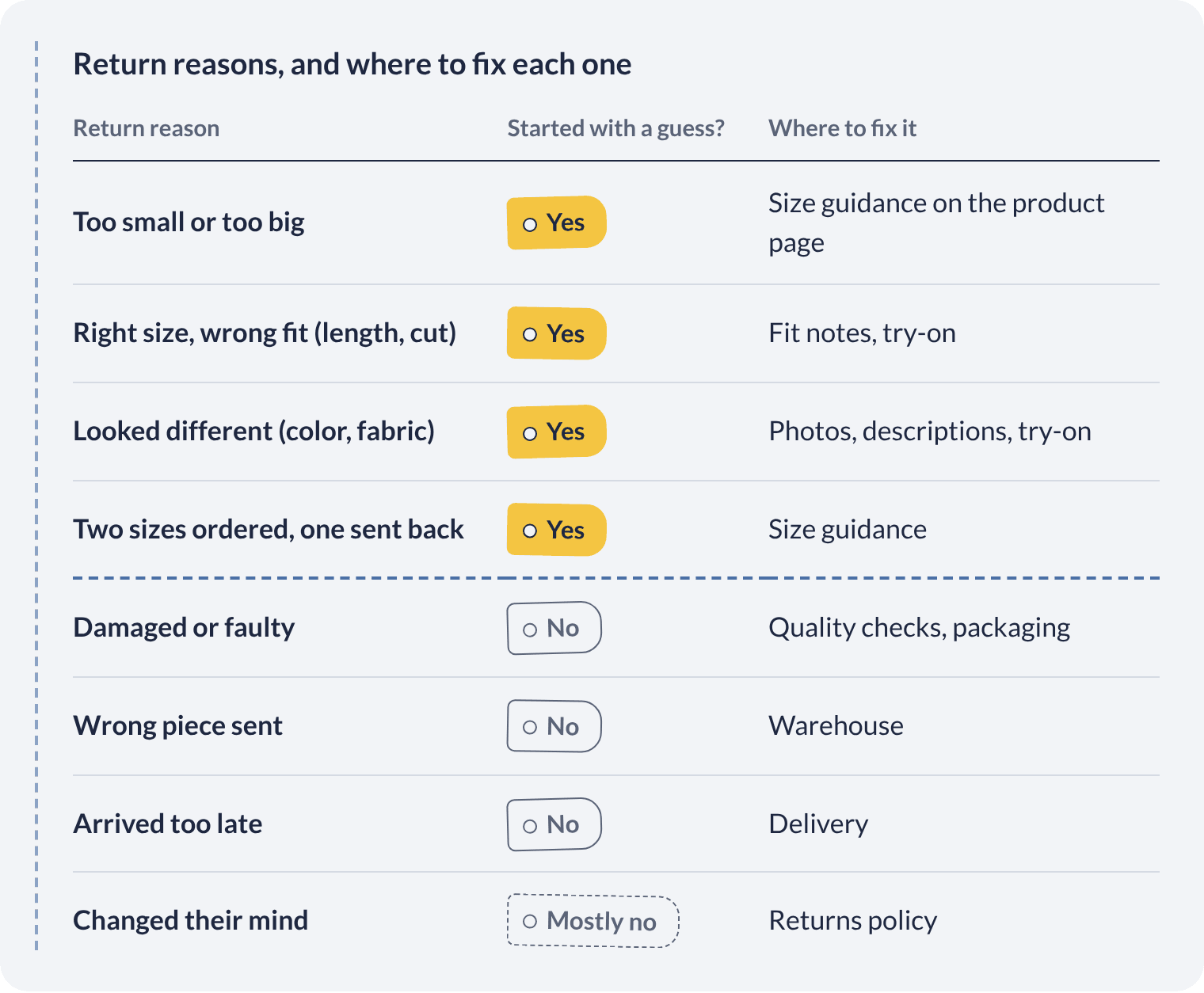
Here is how to run the count on your own store:
- Export your returns from the last 90 days.
- Put each return into one row of the table above.
- Count orders that had the same piece in two sizes. Add them to the guess group, whatever reason the shopper gave.
- Divide the guess group by your total returns.
That share is your target. If it is small, your problem sits in quality, delivery, or policy, and the fixes below will not move it much. If it is large, keep reading.
How to reduce size and fit returns
Reduce size and fit returns by answering "what's my size?" on the product page. Start with the free fixes, then add a tool.
- List garment measurements. A size chart with only body measurements leaves the shopper to work out the fit. Add the measurements of the piece itself, in centimeters and inches.
- Write a fit note for each piece. Your returns already tell you what to say. If a blazer keeps coming back as "too small," put "Runs small. Size up if you are between sizes" on its page.
- Show the model's height and size. "Model is 5'7" and wears a size M" tells the shopper how the length will sit on them.
- Ask one fit question in every review. Runs small, true to size, or runs large. Show the result next to the size picker.
- Treat each category on its own. A size M means different things in a tailored blazer, a pair of jeans, and a kurta set. Check each chart against the pieces you sell.
- Suggest one size. A size recommendation tool asks the shopper a few questions and names the size most likely to fit. The shopper adds one size to the bag.
Steps 1 to 5 cost nothing but time. Start with your ten most returned pieces. Fix those pages, then work down the list.
Step 6 is where a tool helps, because nobody can write a fit note for every shopper. Styailist's AI Size Recommendation suggests a size from each shopper's profile and fit preferences. It is designed to help reduce the returns that start with a size guess.
How to reduce "not what I pictured" returns
Reduce these returns by showing the piece as it will arrive. The shopper pictured one thing from your page and opened the parcel to another.
- Show the piece on more than one body. One model at one height answers the question for very few shoppers.
- Photograph color in daylight. Add one close-up of the fabric so the shopper can see texture and sheen.
- Name colors plainly. If the piece is rust, call it rust, and say whether it leans orange or brown.
- Describe the fabric in plain words. Say whether it is light or heavy, whether it stretches, and whether it is lined or sheer.
- Let shoppers try it on. With virtual try-on, a shopper sees the piece on themselves on the product page.
Try-on and size guidance answer different questions. Try-on answers "will this suit me?" Size guidance answers "what's my size?" A shopper who gets both orders with fewer guesses.
What should you track?
Track four numbers that fall when shoppers stop guessing, and one that should not fall with them.
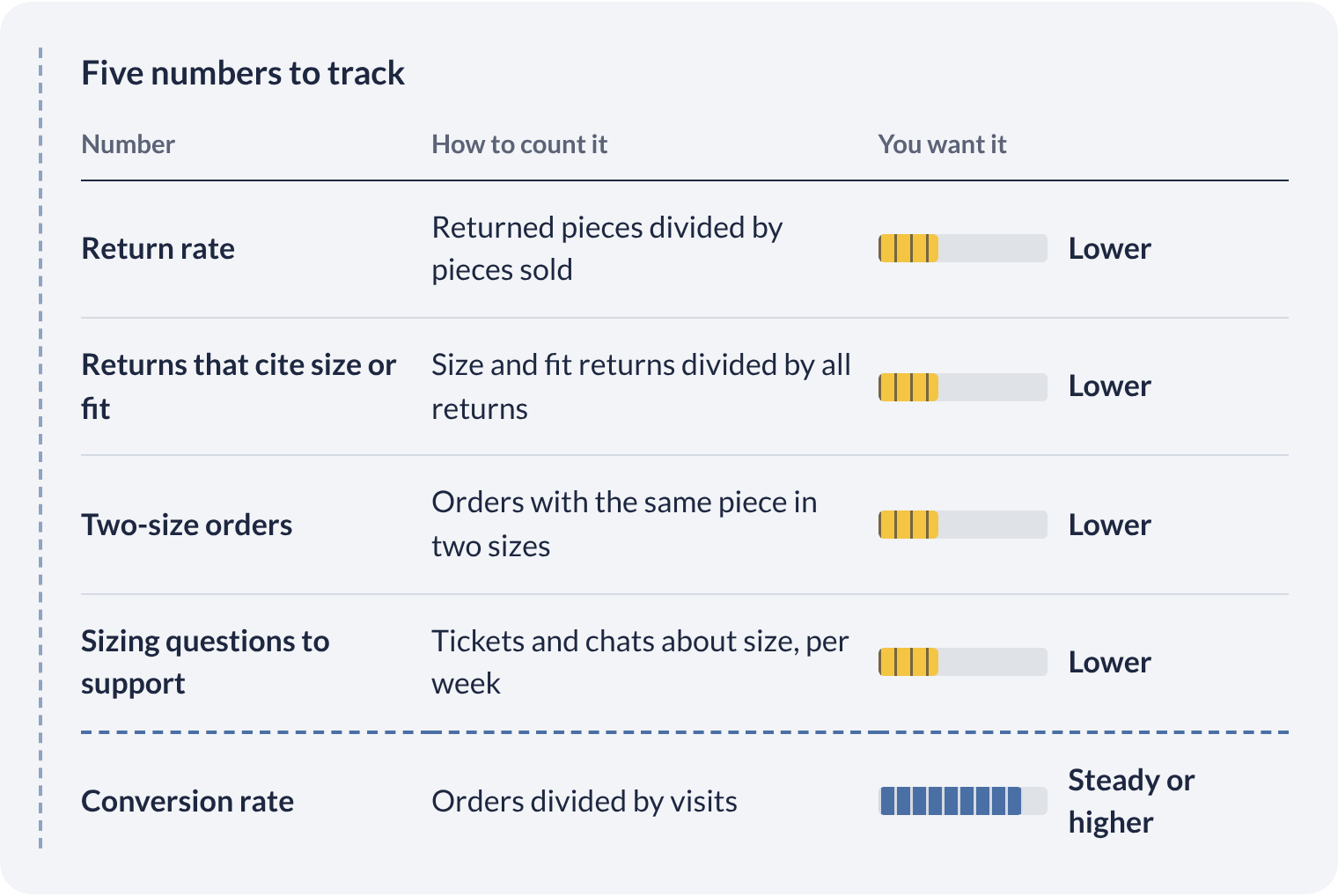
Conversion rate is the safety check. A stricter policy can cut returns and cut orders with them. Better size guidance should cut returns and keep the orders.
Record all five for 90 days before you change anything. Then compare the same length of time after. Compare by category, because dresses and denim behave differently. Leave sale weeks and festive peaks out of the comparison, or compare them with the same weeks last year.
Where should you start?
Start with your own returns data, then fix your most returned pieces. A first month can look like this:
- Week 1: Sort. Export 90 days of returns and count the ones that started with a guess. Record your five numbers.
- Week 2: Fix ten pages. Add garment measurements and a fit note to your ten most returned pieces.
- Week 3: Fix the photos. Add model height and size, a fabric close-up, and a fit question in reviews.
- Week 4: Test a tool. Try size recommendation or virtual try-on on one category, and keep the rest of the store as your comparison.
Questions fashion brands ask about returns
What is a normal return rate for online fashion?
Coresight Research put the average at 24.4% of online apparel orders in the US in 2023. Use it as a rough guide only. Your own rate, tracked by category and over time, tells you more.
What is the main reason for fashion returns?
Size and fit. In the Coresight survey, 53% of apparel brands and retailers named it as the top reason, ahead of color at 16% and damage at 10%.
What is bracketing?
Bracketing is when a shopper orders the same piece in two or more sizes and plans to send back the ones that do not fit. It is a sign that your size guidance is not giving a clear answer.
Should I make my returns policy stricter?
Fix the guess first. A stricter policy can lower returns, but it can also stop shoppers from ordering. Once fewer orders start with a guess, review your policy with cleaner data.
Does virtual try-on reduce returns?
Virtual try-on is aimed at one kind of return: the piece that looked different than the shopper pictured. No tool stops every return. Test it on one category and compare your numbers before and after.
Fewer guesses, fewer returns
Many fashion returns start before checkout, with a guess about size, fit, or look. Count those returns, fix the pages behind them, and track five numbers to see what changed.
For the wider picture, read our complete guide to AI styling for fashion ecommerce. Or see how Styailist helps reduce returns with size recommendations and virtual try-on.
Book a demo to see it on your store.